Search

This site uses cookies
By clicking “Accept,” you agree to the storing of cookies on your device to enhance site navigation, analyze site usage, and assist in our marketing efforts. View our Privacy Policy for more information.


Every new patient arrives with a history, a set of expectations, and a reason for choosing your pharmacy. They may be transferring prescriptions after years with another provider, looking for more personalized service, or simply searching for a pharmacy that makes managing medications easier.
What happens during that first interaction can influence whether they become a long-term patient or keep looking.
A strong pharmacy patient welcome experience should do more than collect contact and insurance information. It should help patients feel recognized, introduce them to useful services, and establish how your team will communicate with them. For independent pharmacies focused on improving pharmacy patient engagement, that first visit is an opportunity to show what personal, community-based care looks like.
The right pharmacy software can support this process by bringing patient information, communication preferences, notifications, services, and follow-up tasks into a connected workflow.
Technology shouldn’t replace the human welcome. It should give your team more time and better information to make that welcome meaningful.
With a clear process, your pharmacy can turn that first interaction into the beginning of a lasting relationship. The following five steps can help you create a smoother, more personal welcome for every new patient.
The pharmacy patient intake process is often the patient’s first operational experience with your pharmacy. If it involves repetitive questions, unclear forms, or a long wait while staff enters information, the relationship can get off to a frustrating start.
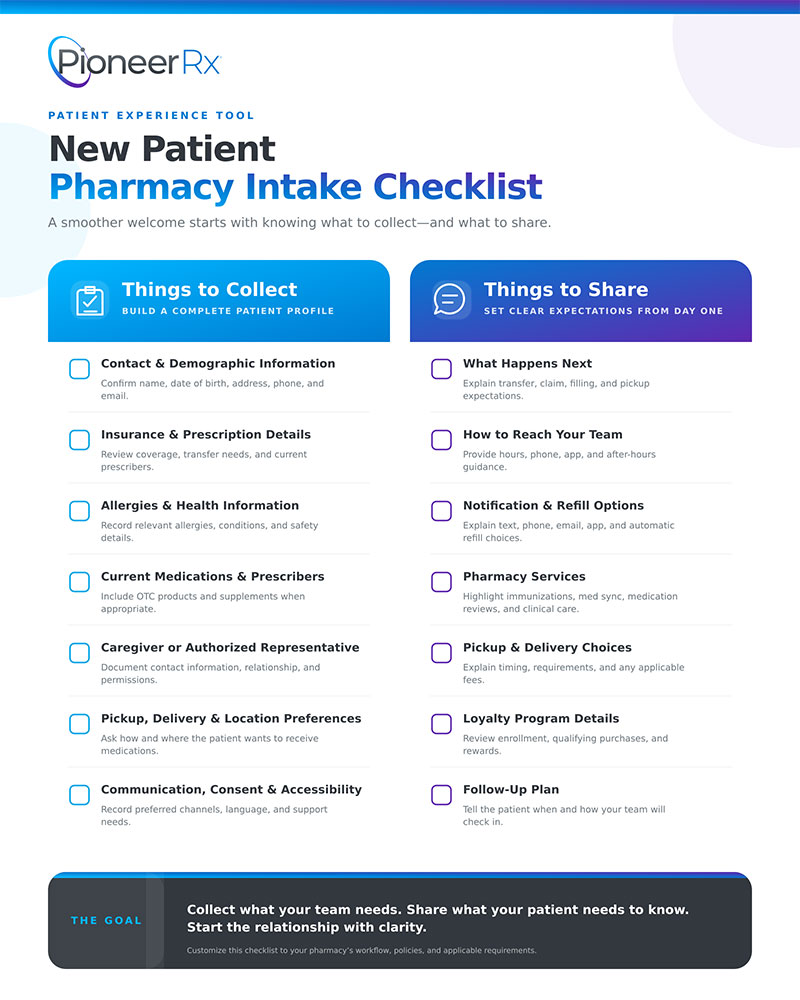
Improving pharmacy new patient intake begins with deciding what information your team truly needs and creating a consistent way to collect it. Depending on the patient and the services they’re requesting, this may include:
Avoid asking patients to provide the same information multiple times. If details are already available through a prescription transfer, electronic prescription, insurance lookup, or scanned identification, confirm them instead of starting over. Explain why you’re requesting sensitive information and how it will be used. A little context can make the process feel more thoughtful and less transactional.
Simplicity doesn’t mean rushing. It means removing unnecessary friction so your team can spend more of the first interaction learning about the person in front of them.
It also helps to create a pharmacy new patient checklist for staff. The checklist shouldn’t turn the welcome into a script, but it can ensure essential steps aren’t missed during a busy shift. Train team members to confirm the information carefully, identify unanswered questions, and tell the patient what will happen next.
Some patients want a text message as soon as a prescription is ready. Others prefer a phone call, email, or mobile app notification. Asking about these preferences early can prevent missed messages and make future communication more useful.
Don’t stop at asking for a phone number or email address. Find out how the patient would like to receive different types of information. Their preference for a refill reminder may differ from how they’d want to discuss a medication problem or clinical service.
Questions might include:
Document the answers in a place where staff can find and use them. Preferences aren’t valuable if they’re written on a paper form and forgotten.
What pharmacy software systems help improve patient communication? Look for a system that connects patient profiles with customizable notifications, refill reminders, mobile messaging, and workflow tools. The goal is to help staff communicate consistently without forcing every update into a separate system or relying on memory.
Improving pharmacy patient engagement depends on meeting patients where they are.
Give patients choices, but don’t assume everyone wants to use every digital channel. A mobile app may be convenient for one patient, while a personal phone call may be more appropriate for another.
New patients may know you fill prescriptions, but they may not realize how many other ways your pharmacy can support their health. The welcome process is an ideal time to introduce relevant services before a need becomes urgent.
Depending on your pharmacy, those services might include:
A long list of services can be difficult to absorb, especially when someone is waiting for a prescription. Instead, use the information gathered during intake to guide the conversation.
A patient managing several maintenance medications may benefit from medication synchronization or adherence packaging. Someone with limited transportation may want to know about delivery. A patient receiving a vaccine may be interested in other preventive or clinical services. The goal isn’t to promote everything at once. It’s to connect each patient with services that may solve a real problem.
Provide a short welcome card, printed service guide, email, or app message the patient can review later. Make sure staff can explain how each service works, whether there’s a cost, and what the patient needs to do next.
This approach positions onboarding as the beginning of an ongoing care relationship. It also shows what distinguishes an independent pharmacy: the ability to notice individual needs and respond with personal, practical support.
A pharmacy loyalty program can give new patients another reason to return while helping your pharmacy recognize and reward ongoing support. Because the first visit already includes collecting patient information and explaining pharmacy services, it’s a natural time to offer enrollment.
Keep the program easy to understand. Patients should know:
Don’t make enrollment feel like another stack of paperwork. A brief explanation at checkout may be enough: describe the benefit, ask whether the patient would like to participate, and complete the setup within the same workflow when possible.
A loyalty program can support more than front-end sales. It can make patients feel appreciated and strengthen their connection to a locally owned business.
It can also give the pharmacy useful insight into participation and purchasing patterns, helping the team evaluate whether the program is delivering meaningful value.
PioneerRx offers an integrated loyalty program through its point-of-sale functionality. Pharmacies can assign loyalty IDs, track points, set reminders, and use reports to evaluate program activity. As with any program, pharmacies should establish clear rules and ensure rewards comply with applicable laws, payer requirements, and company policies.
The welcome experience shouldn’t end when the patient walks out the door. A thoughtful follow-up can reinforce the relationship and uncover problems before they affect adherence or satisfaction.
Depending on the situation, follow-up could happen through a phone call, email, text, or mobile app. Use the method the patient selected during intake, and make the message relevant to their experience.
You might follow up to:
Avoid turning every follow-up into a promotion. A simple question such as “Did everything go smoothly with your first prescription?” can provide valuable insight and show that your pharmacy pays attention.
Create a repeatable process for deciding which patients need follow-up, who’s responsible, and when it should happen. Document the interaction so another staff member can understand what was discussed and what still needs to be done.
Follow-up also helps your pharmacy improve. If several new patients mention the same confusing form, missed notification, or delay, you’ve identified an opportunity to strengthen the welcome process for everyone who comes next.
PioneerRx is a good fit for independent pharmacies that want a customizable system connecting patient intake, workflow, communication, clinical care, point-of-sale activity, and reporting. Because independent pharmacies don’t all operate the same way, PioneerRx allows teams to configure workflows around their services and processes.
Features within PioneerRx pharmacy software can help reduce friction throughout the welcome experience. For example, 2D barcode technology can populate patient information from a compatible ID, while insurance and prescriber lookup tools can reduce manual searching. Patient profiles, customizable workflows, notifications, and integrated service documentation help staff capture information and act on it without depending on paper notes or memory.
The RxLocal app extends that connection beyond the pharmacy counter. Patients can submit refill requests, view prescription information, receive refill reminders, and participate in HIPAA-compliant two-way conversations with their pharmacy. Staff can respond through the Message Center within PioneerRx, helping communication become part of the pharmacy’s regular workflow.
Software alone won’t create a welcoming experience. Your team’s attention, empathy, and follow-through will always matter most.
But when the right technology supports those qualities, staff can spend less time repeating questions, switching systems, and tracking down information, and more time helping new patients feel confident in their choice.
A better welcome doesn’t need to be complicated. Make intake easy, ask how each patient wants to communicate, introduce services that fit their needs, offer meaningful ways to stay connected, and follow up after the first visit. Those small, intentional steps can turn a first prescription into a lasting relationship.
Ready to see how PioneerRx can support a more connected patient experience? Request a PioneerRx demo today and explore the tools available for independent pharmacies.